
EXPRESS ENTRY CEC DRAW: CRS CUT-OFF RISES TO 519 FOR CANADIAN EXPERIENCE CLASS CANDIDATES

EXPRESS ENTRY CEC DRAW: CRS CUT-OFF RISES TO 519 FOR CANADIAN EXPERIENCE CLASS CANDIDATES
Canada has returned to the Canadian Experience Class (CEC) in Express Entry. On October 15, 2026, Immigration, Refugees and Citizenship Canada (IRCC) invited 2,500 candidates with Canadian work experience to apply for permanent residence, and set the minimum Comprehensive Ranking System (CRS) score at 519. If you are working in Canada and hoping to transition to permanent residence, here is what the round means for you.
Draw results at a glance
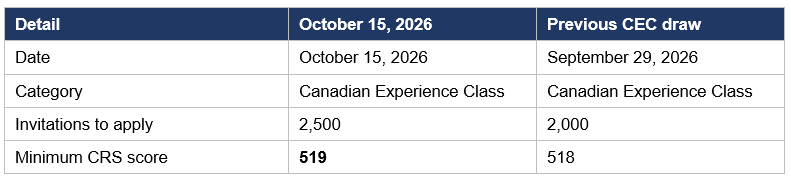
The cut-off rose by one point compared with the previous CEC round, and the round was 500 invitations larger. The tie-breaking rule was September 21, 2026, at 19:00:47 UTC: when several candidates had exactly 519 points, only those whose profiles were submitted before that date and time were invited.
How the CEC fits into this year's draws
Between the previous CEC round and this one, IRCC also held a Provincial Nominee Program draw on October 13, which invited 752 candidates with a minimum score of 772. That score is high because a provincial nomination adds 600 points. With the October 15 round, IRCC has now issued 138,467 invitations across 61 Express Entry draws in 2026.
Why it matters: CEC rounds are not scheduled on a fixed calendar. Candidates who already hold a score near the recent cut-offs need a complete, up-to-date profile so that they can act quickly when an invitation arrives.
Who can qualify for the Canadian Experience Class?
The CEC is designed for people who have already worked in Canada. Based on IRCC's published requirements, candidates generally need:
• At least one year of skilled work experience in Canada in the three years before applying, in a job classified as TEER 0, 1, 2 or 3 under the National Occupational Classification.
• Work experience gained with proper authorization. Time worked as a student or without authorization does not count, and self-employment does not qualify.
• Minimum language results from an approved test: Canadian Language Benchmark (CLB) 7 for TEER 0 or 1 jobs, and CLB 5 for TEER 2 or 3 jobs.
• Plans to live outside Quebec.
There is no minimum education requirement for the CEC, although education still earns CRS points. Because rules and thresholds are updated from time to time, they should always be checked on canada.ca before you rely on them.
What to do if your score is below 519
• Retake your language test. Higher language results are often the fastest way to add points.
• Add French. Strong French results can add significant points, and French-language draws have been held separately.
• Update your work experience. Each additional year of Canadian experience can raise your score.
• Explore provincial nomination. A nomination adds 600 points and places a candidate in a different draw.
• Check your status. If your work permit is close to expiring, plan ahead so that you do not lose your options.
A profile in the pool is not the same as a strong application. Errors in work history, mismatched job duties or expired documents can cost an invitation or lead to a refusal after you apply.
Where does your profile stand in the Canadian Experience Class?
Your CRS score is only part of the picture. Global Opportunities will review your work experience, language results and status, show you how your score compares with recent cut-offs and outline the strongest route to permanent residence for you. Contact us today to book an assessment with Global Opportunities and find out which path fits your situation.
Source: Immigration, Refugees and Citizenship Canada, Express Entry rounds of invitations (draws of October 13 and October 15, 2026) and Canadian Experience Class eligibility information. Program rules and thresholds may change; confirm on canada.ca before applying. This article is for general information only and is not legal advice.